Choosing between a concrete and a paver patio is one of the biggest decisions in any backyard renovation, and East Tennessee homeowners face a wrinkle that flatter, sandier regions don’t: red clay soil, sharp freeze-thaw swings, and heavy spring downpours.
Both materials are popular across Knoxville, Sevierville, and the surrounding Tennessee Valley, and both can look fantastic. But when you weigh concrete vs pavers Tennessee homeowners actually deal with, expansive clay that swells and shrinks, winter frost heave, and drainage headaches, one material tends to hold up noticeably better over time. This guide breaks down the real differences in cost, durability, and climate performance so you can choose with confidence.
Quick Comparison Table
| Factor | Concrete | Pavers |
| Cost | Lower upfront ($6–$15/sq ft) | Higher upfront ($10–$20+/sq ft) |
Concrete Patios, Pros & Cons
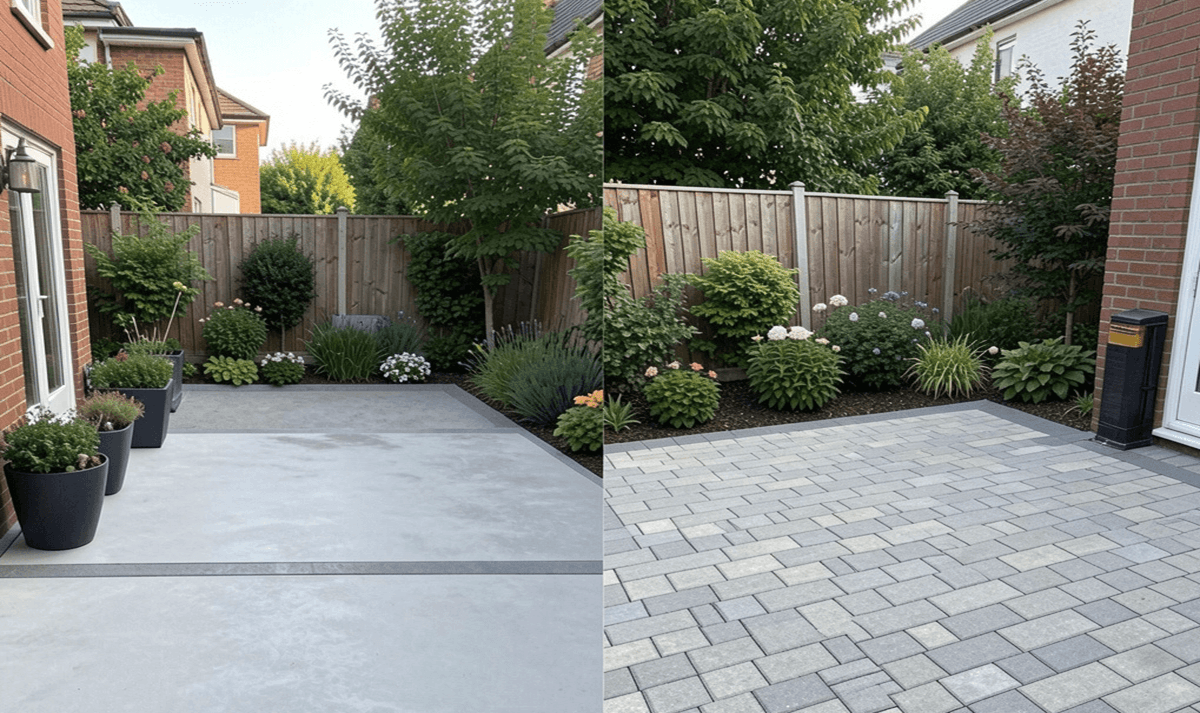
Concrete remains a go-to choice for homeowners who want a clean, budget-friendly patio without a long installation timeline. A crew can typically pour and finish a standard patio in a matter of days, and the seamless slab gives you a modern, minimalist look that pairs well with contemporary home designs. Concrete also offers flexibility through stamping, staining, and coloring, so you’re not limited to plain gray if you want a decorative finish.
The tradeoffs show up over time. Concrete is a rigid material, which means it doesn’t flex when the ground beneath it moves, and in East Tennessee, the ground moves a lot. As slabs age, they’re prone to cracking, especially at control joints and edges where moisture collects. Once a crack forms, repair options are limited: you can patch it, but the color and texture rarely match perfectly, and full-panel replacement is often the only way to restore a uniform look. Sealed or smooth-finished concrete can also become slippery when wet, which is worth considering near pools or shaded patios that stay damp longer.
Paver Patios, Pros & Cons
Pavers are the higher-end choice for homeowners prioritizing long-term durability and design flexibility. Because pavers are installed as individual interlocking units over a compacted gravel base and sand bedding, rather than poured as one rigid slab, they naturally flex with soil movement instead of cracking. This makes them exceptionally well-suited to variable ground conditions. Pavers also come in a huge range of colors, shapes, and patterns, giving you far more design control than a poured slab. Their textured surface provides better slip resistance, and the small gaps between units allow water to drain through rather than pool on the surface.
The main drawback is upfront cost: paver installation is more labor-intensive, since it requires excavation, a deep gravel base, sand leveling, and careful compaction, all of which adds to the price tag. If your site also needs significant grading or drainage correction before installation, our excavation services team often handles that groundwork as part of the same project. Weeds and ants can also work their way into the joints between pavers over time, though modern polymeric sand largely solves this by hardening into a seal that resists both weed growth and erosion from heavy rain.
East Tennessee–Specific Factors
The single biggest variable in the concrete vs pavers Tennessee decision is what’s happening underground. Much of East Tennessee sits on expansive red clay that swells when saturated and shrinks as it dries, a cycle that repeats constantly given the region’s heavy spring rains. That swelling and shrinking, repeated over time, is enough to push pavers out of alignment and open up joints if the base isn’t properly engineered. Add winter freeze-thaw cycles into the mix, and the moisture in clay-heavy soil freezes and expands, heaving slabs upward; as it thaws, the ground contracts, and over multiple cycles this leads to uneven, tilted, or cracked concrete.
Concrete’s rigidity is precisely what makes it vulnerable here: a solid slab has nowhere to go when the clay beneath it swells or contracts, so stress concentrates at joints and edges until cracks form. Pavers, by contrast, are built on a flexible gravel base designed to move with the soil rather than fight it, a deep base of compacted crushed stone and bedding sand allows the pavers to shift with clay soil without cracking. Proper drainage and grading matter for both materials, but pavers generally tolerate East Tennessee’s clay and freeze-thaw conditions with less long-term damage.
Cost Comparison
Concrete patios typically run $6–$12 per square foot installed in East Tennessee, making them the more budget-friendly option upfront, a 300-square-foot patio might land between $1,800 and $3,600. Paver patios cost more initially, generally $10–$20 per square foot installed, putting that same 300-square-foot patio in the $3,000–$6,000 range, with premium stone or intricate patterns pushing higher.
The gap narrows, and often reverses, once you factor in the full lifecycle. Concrete needs periodic resealing and, when it cracks, either unsightly patchwork or a costly full-panel replacement. Pavers let you replace a single damaged unit for a fraction of that cost without disturbing the rest of the patio, which is why many contractors and homeowners find pavers more cost-effective over a 15–20 year horizon despite the higher sticker price. For a full size-by-size cost breakdown across both materials, see our companion guide, How Much Does Patio Installation Cost in Tennessee?.
The Verdict
There’s no universal right answer, but there is a clear lean for most East Tennessee homeowners. If your budget is flexible and you’re planning to stay in your home long-term, pavers are the stronger investment, they handle clay soil movement and freeze-thaw cycles more gracefully, they’re far easier to repair, and they hold their appearance longer. If you’re working with a tighter budget, need a large flat area covered quickly, or want a minimalist look for a shorter-term home, concrete remains a solid, cost-effective choice, just budget for maintenance and be aware of crack risk over time. Either way, proper site prep and drainage matter more in this region than the material choice itself.
FAQs
Concrete is cheaper upfront, typically $6–$12 per square foot installed versus $10–$20+ for pavers. However, pavers often cost less over the long run because individual units can be repaired cheaply instead of requiring full-slab replacement.
Pavers themselves rarely crack because they’re small, individual units set in a flexible sand and gravel base. They can shift slightly during freeze-thaw cycles, but a properly compacted base and polymeric sand joints minimize this movement and keep the surface stable.
Yes. One of the biggest advantages of pavers is that individual units can be lifted, replaced, or releveled without disturbing the rest of the patio, a repair that typically costs a small fraction of what a comparable concrete repair would run.
It depends on style preference. Concrete offers a clean, seamless, modern look and can be stamped or stained for texture. Pavers offer far more variety in color, shape, and pattern, giving a more custom, upscale appearance that many homeowners prefer for curb appeal and resale value. For more on choosing a material for your specific space, see our related post, How to Choose the Right Material for Your Patio or Walkway.
Ready to transform your outdoor space? Explore Appalachian Scapes’ full landscaping services or contact the team directly for a free estimate on your project.