
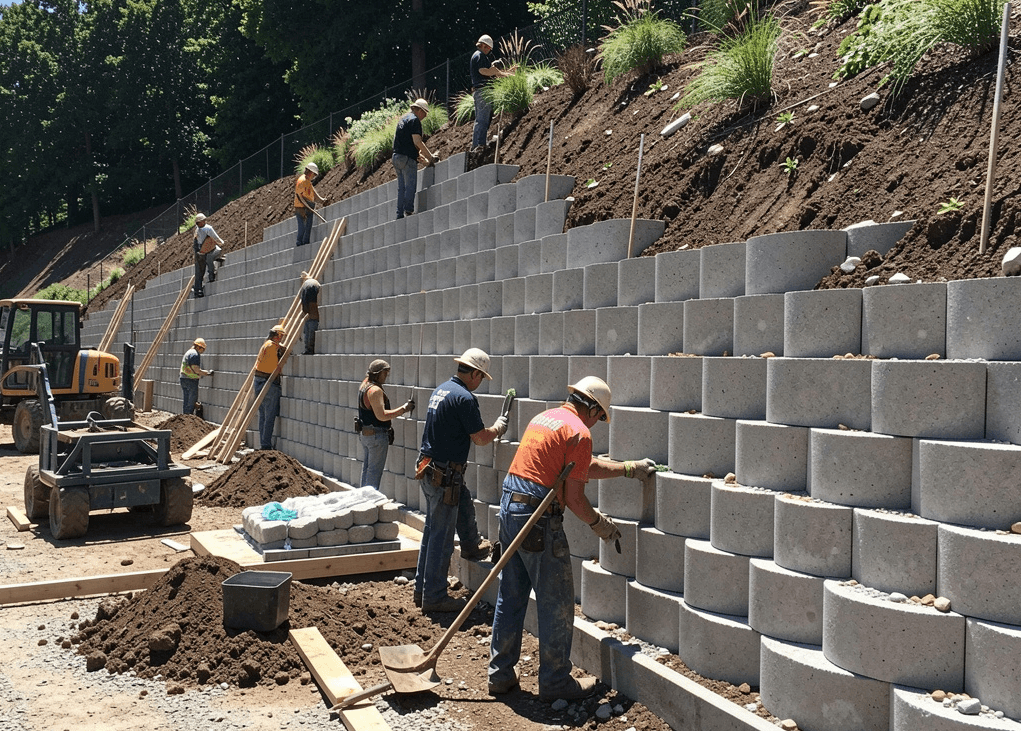
Retaining wall cost in Tennessee typically ranges from $3,000 to $15,000, with the average residential project landing around $5,000–$9,000. Your final price depends mainly on wall height, length, material, drainage requirements, and how difficult your Tennessee terrain is to work with.
Retaining walls are one of the most practical investments a homeowner can make, they stop erosion, create usable flat space on a slope, and protect foundations from water and soil pressure. But because pricing swings so widely by material and site conditions, it helps to understand what actually drives retaining wall cost Tennessee homeowners can expect before you request a quote. This guide breaks down pricing by material, the factors that move your number up or down, and what to budget for if you’re building in the hillier parts of East Tennessee.
Cost by Material
Timber is the most budget-friendly option and installs quickly, making it popular for shorter walls (under 3 feet) or temporary landscaping needs. Its main drawback is lifespan, pressure-treated wood typically breaks down within 10–20 years, especially in a humid climate like Tennessee’s, meaning many homeowners end up rebuilding a timber wall two or three times over the life of a more durable alternative.
Concrete block (also called segmental retaining wall, or SRW) is the most common choice for residential projects and generally offers the best balance of cost and durability. Interlocking blocks don’t require mortar, can be reinforced with geogrid fabric for taller walls, and hold up for 50 years or more with minimal maintenance.
Poured concrete walls are formed and cast on-site, giving a seamless, highly engineered structure well-suited to taller or load-bearing applications. The tradeoff is cost and installation time, poured walls require formwork, curing time, and often structural engineering for anything beyond a modest height.
Natural stone sits at the top of the price range because of labor, not material, fitting irregular stones by hand is slow, skilled work. In exchange, you get a premium, custom look that many homeowners consider worth the investment, along with an exceptionally long lifespan.
Cost Factors
Wall height. Height is the single biggest cost driver, and the relationship isn’t linear, a 6-foot wall can cost 2–3 times more per square foot than a 3-foot wall. Once a wall exceeds about 4 feet, it typically requires geogrid reinforcement, a deeper footing, and often a stamped engineering drawing, all of which add significant cost.
Length of wall. Cost scales with total wall face area (length × height), so longer walls cost more in raw dollars even though the per-square-foot rate may improve slightly with economies of scale on larger projects.
Terrain difficulty. Steep or uneven slopes make excavation, material staging, and equipment access harder, which increases labor time and, in turn, cost.
Drainage requirements. Every properly built retaining wall needs a drainage system, gravel backfill, perforated pipe, and filter fabric, to relieve water pressure behind the wall. Skipping this is the #1 cause of wall failure, and adding it typically costs $300–$2,500 depending on wall size.
Permit requirements. Most Tennessee jurisdictions require a permit for walls over 3–4 feet tall, and taller walls often need engineered drawings. Permit fees generally run $150–$800, plus $800–$3,500 for engineering if your wall requires it.
Soil conditions. Tennessee’s clay-heavy soil holds water and expands significantly when saturated, which increases the pressure a wall must resist. Poor or unstable soil sometimes requires over-excavation and engineered backfill to create a stable base, adding to cost.
Site access for equipment. Backyards with limited access for skid steers or mini-excavators may require more manual labor or smaller equipment, which slows the job and raises labor costs.
East Tennessee Terrain Premium
Homeowners in Sevier County and the areas surrounding the Smoky Mountains face a real terrain premium. Rocky subsoil, steep grades, and limited equipment access are common on lots throughout this region, and all three factors compound labor time and material handling costs. As a rule of thumb, expect 15–30% above typical statewide pricing for retaining wall projects in these steeper, rockier areas compared to flatter terrain elsewhere in Tennessee. The upside is that a well-built wall does more work here, stabilizing slopes and creating usable yard space is often more valuable on mountainous lots than on flat ones.
Steep or heavily wooded sites often need dedicated site work before a wall can even go in. See our related breakdown, What Is the Typical Excavation Cost for Residential Projects? for what that grading and prep work typically runs.
DIY vs. Professional Installation
For short walls, generally under 2 feet, a motivated homeowner can reasonably tackle a DIY build with basic tools and a weekend of work. Beyond that height, we strongly recommend professional installation. Retaining walls over 2 feet are structural elements: they’re holding back real soil weight and hydrostatic pressure, and a wall that isn’t properly engineered, based, and drained can fail, sometimes suddenly and without much warning. A collapsed wall can damage property, create a serious safety hazard, and end up costing far more to fix than it would have cost to build correctly the first time. Professional installers also carry the insurance and local code knowledge needed to navigate permit requirements, which DIY builds often overlook until it becomes a problem at resale.
How to Get an Accurate Quote
Because so much of your final cost depends on things you can’t measure from a photo, exact terrain slope, soil composition, drainage needs, and site access, the only way to get a truly accurate number is an in-person estimate. We offer free on-site estimates: a contractor will assess your wall height and length, evaluate your soil and drainage situation, and check equipment access before putting together a detailed quote, so you know exactly what you’re paying for before work begins.
FAQs
Timber is generally the cheapest option upfront, at $15–$25 per square foot installed. However, its 10–20 year lifespan means it often needs replacing sooner than concrete block or stone, which can make it more expensive over the long run.
Lifespan varies by material: timber walls typically last 10–20 years, while concrete block, poured concrete, and natural stone walls can last 50–100 years or more with proper drainage and occasional maintenance.
Yes. A well-built retaining wall increases usable yard space, prevents erosion, and improves curb appeal, all of which contribute to resale value, particularly on sloped or hillside properties where usable flat space is limited.
For short walls under 2 feet, a DIY build is realistic for a capable homeowner. For anything taller, professional installation is strongly recommended, since taller walls carry real structural and safety risks if not properly engineered and drained.
Yes. We provide free on-site estimates so we can accurately assess your wall height, terrain, soil conditions, and drainage needs before giving you a quote.
Ready to get a quote for your project? Explore our retaining wall services →, Or go straight to scheduling: Request your free on-site estimate.